





Breach of a Non-Competition Clause in a Joint Commodity Index Cooperation Agreement: How Should Damages be Calculated in the Absence of a Penalty Clause?
In a complex dispute arising from a cooperation agreement for the joint creation and commercialization of a commodity index, the Federal Supreme Court addressed three main questions. First, an objective interpretation of the non-competition clause which prohibited the use of any other index reproducing the mechanisms of the Common Index “outside the framework of the contract” could not be understood as authorizing such competing use in exchange for payment of the contractual remuneration. Second, in the absence of a genuine contractual gap, arts. 536 and 464 para. 2 of the Swiss Code of Obligations (SCO) could not be applied by analogy to require the surrender of profits derived from the competing activity. Third, the fact that the contract specified neither the consequences of a breach of the disputed clause nor the method for calculating the resulting damage could amount to a mere “imperfection of the contract”: a specific contractual regime governing sanctions is not necessary to establish the damage, since the breach triggers the contractual liability of the breaching party under the general rules (arts. 97 seq. and 98 para. 2 SCO) and entitles the injured party to compensation for its positive interest, i.e. the remuneration it would have received on the Common Index.
Judgment of the Federal Supreme Court of February 2026
Case Reference : 4A_83/2025
Facts
The Federal Supreme Court’s judgment concerns a contractual dispute between two companies operating in the financial industry, A. SA and B. SA, together (the “Parties”).[1] A. SA, which specializes in the creation and management of commodity-related financial indices, was founded by established figures in the industry, including F., the creator of the “S.” index.[2] A. SA obtained a license to promote said index outside the United States and also developed its own index, namely the “M.” index.[3] B. SA, a company incorporated under French law, is one of the world’s leading companies in commodity trade finance.
On April 12, 2007, the Parties entered into a cooperation agreement drafted by A. SA (the “Contract”). The Contract aimed to establish a framework of cooperation between the Parties regarding the creation and commercialization of a new commodity-related financial index (namely the “N.” index)[4], which had been created on the basis of the “M.” index developed by A. SA, to which B. SA had added a quantitative enhancement algorithm (the “Common Index”).[5] The Contract provided for a remuneration mechanism benefitting both Parties (art. 4): B. SA was required to pay A. SA an annual commission calculated on the hedging amount relating to products referencing the Common Index (0.70%, or 0.30% for single-commodity products). These rates were reduced to 0.50% and 0.20% respectively, as of July 1, 2008. This remuneration is referred to as the “Remuneration”. In return, A. SA was required to pay B. SA retrocessions of 0.30% per year on the amount of its own hedging and of 0.15% per year on all assets under management excluding that hedging amount. The respective commissions payable by each Party were set off.[6] The Contract also contained a non-competition clause (art. 7) (the “Non-Competition Clause”), drafted as follows:
“7.1 Each party undertakes, both for itself and for any natural or legal person affiliated with it, throughout the entire duration of the present Contract, not to use, directly, the N. Index or any other index reproducing the mechanisms of the N. Index as described in its manual, outside the framework of the present Contract.”
The dispute arose when B. SA began using a third-party index, the “O.” index[7], launched on January 27, 2011 (the “Competing Index”). The index had been developed by company H. (namely S&P Global), with which B. SA, through an entity it controlled, had entered into a license agreement dated January 1, 2007, effective as of March 1, 2011. The agreement concerned the use of the world’s leading equity index and of the indices belonging to the “O.” family. In December 2010, B. SA launched a first product referencing the Competing Index by redirecting products that had initially referenced the Common Index. According to the facts established in the judgment, “this [O.] index was more attractive to investors than the N. index due to the fact that both company H. and its index were significantly better known than the claimant [A. SA] and its index in the field, particularly in the United States.”[8]
- SA considered that such use violated the Non-Competition Clause. By email dated October 25, 2011, it therefore requested that B. SA either cease using the Competing Index or pay the Remuneration on it. On February 2, 2012, B. SA terminated the Contract with immediate effect, a termination whose unjustified nature it ultimately no longer disputed. Had it remained in force, the Contract would have expired on April 12, 2017.
In the subsequent proceedings, A. SA sought payment of the Remuneration on the products linked to the Competing Index. It argued that the prohibition on using a third-party index “outside the framework of the Contract” necessarily implied that such use had to take place “within the framework of the Contract”, that is, in exchange for payment of the Remuneration provided for under art. 4. On this basis, A. SA increased its claim from USD 11,831,734.58 to USD 57,454,921.89. In a judgment dated September 21, 2021, the Chambre patrimoniale cantonale of the Canton of Vaud (the “First Instance Court”) partially upheld the claim and ordered B. SA to pay USD 52,218,922 plus interest at 5% as of February 2, 2012.
By judgment dated January 7, 2025, the Civil Court of Appeal of the Cantonal Court of the Canton of Vaud (the “Cantonal Court”)[9] partially upheld B. SA’s appeal and reduced the amount awarded to USD 6,559,644 plus interest. It rejected A. SA’s interpretation of the Non-Competition Clause. A. SA subsequently appealed to the Federal Supreme Court, alleging that the facts had been established in a manifestly inaccurate manner and that the Contract had been interpreted arbitrarily.
Issue
The Federal Supreme Court had to address three questions:
- Methods of contractual interpretation: Did the Cantonal Court correctly apply the subjective and objective methods of interpretation when it held that the Non-Competition Clause did not make the use of the Competing Index conditional upon payment of the Remuneration provided for in art. 4?
- Legal characterization of the contract: Given that the Contract had been characterized as a sui generis simple partnership agreement, should 536 and 464 para. 2 SCO have been applied by analogy, thereby requiring B. SA to surrender the profits derived from its use of the Competing Index?
- Financial consequences of the breach of the Non-Competition Clause: How should the damage resulting from the breach of the Non-Competition Clause be calculated in the absence of a specific contractual mechanism governing its financial consequences?
Decision
The Federal Supreme Court began by recalling the two-stage method of contract interpretation. The court must first seek to establish the parties’ real and common intention (art. 18 para. 1 SCO), which is a question of fact. If that intention cannot be established, the court must determine the parties’ objective intention by applying the principle of trust (art. 1 para. 1 SCO in conjunction with art. 2 of the Swiss Civil Code (SCC)), which is a question of law.[10] The Federal Supreme Court found that the Cantonal Court had not clearly distinguished between these two methods, and had moreover established in a manifestly inaccurate manner that A. SA had claimed the Remuneration on the Competing Index for the first time in its reply, whereas it had already made that request in its email of October 25, 2011. However, this factual error concerned only A. SA’s own intention. It was therefore not arbitrary for the Cantonal Court to hold that no real and common intention of the Parties could be established. Since both Parties had made submissions concerning the objective interpretation of the Contract, the Federal Supreme Court was able to review that interpretation.[11]
Turning to the objective interpretation, the Federal Supreme Court distinguished between the two situations covered by the Non-Competition Clause. The use of the Common Index itself, which was the very object of the Contract, could be interpreted as A. SA suggested, namely as giving rise to the Remuneration provided for under art. 4. By contrast, using another index reproducing the mechanisms of the Common constituted competing activity. A clause expressly entitled “non-competition” could not reasonably be understood as permitting such competition in exchange for payment of the Remuneration, particularly since art. 4 concerned only the Common Index. The interpretation proposed by A. SA would have also meant that B. SA was merely in default of payment (arts. 102 seq. SCO) rather than in breach of its contractual obligations under the rules governing non-performance (arts. 97 seq. SCO). Furthermore, it would have been inconsistent with the purpose of the Contract, which was to maximize the dissemination of the Common Index through its exclusive promotion. Finally, the absence of an explicit sanction could be regarded as “a mere imperfection of the contract”. It did not deprive the Non-Competition Clause of either its legal effect or its deterrent purpose.[12]
The Federal Supreme Court then rejected A. SA’s argument based on arts. 536 and 464 para. 2 SCO. Since A. SA was advancing an interpretation of the Contract, it could not simultaneously argue that the Contract contained a gap. The Parties had not provided for a specific compensation mechanism in the event of a breach of the Non-Competition Clause, and this absence did not justify supplementing the Contract by applying the stator provisions relied upon by A. Sa by analogy.[13] The Cantonal Court had therefore correctly applied the general rules governing contractual liability (arts. 97 seq. and 98 para. 2 SCO). It awarded A. SA compensation for its positive interest , corresponding to the Remuneration that B. SA would have continued to pay had it not reduced its use of the Common Index in favor of competing indices.[14] The appeal was dismissed to the extent that it was formally admissible.
Key Takeaways
- Contractual interpretation ( 18 para. 1 SCO): the judge must first seek to establish the real and common intention of the parties (question of fact). Only if that intention cannot be established may it resort to objective interpretation based on the principle of trust (question of law). A cantonal court’s failure to clearly distinguish between he two methods does not necessarily justify setting aside its decision if its reasoning can be understood as an objective interpretation.
- Contractual characterization and gap-filling: the legal characterization of a contract becomes relevant where a mandatory statutory provision must be applied or where a default rule is needed to fill a genuine contractual gap. A party that advances an interpretation of the contract cannot simultaneously argue that the contract contains a gap. The parties’ qualified silence excludes supplementing the contract in this case by applying 536 and 464 para. 2 SCO by analogy.
- Consequences of the breach of the Non-Competition Clause: in the absence of a specific contractual regime (such as a penalty clause), a breach of a non-competition obligation triggers the general rules governing contractual liability ( 97 seq. and 98 para. 2 SCO). The absence of such a contractual mechanism may constitute a mere “imperfection of the contract”, rather than a gap to be filled. The damage corresponds to the positive interest, namely the Remuneration lost in connection with the Common Index.
Comment
The Federal Supreme Court’s decision 4A_83/2025 concerns a non-competition clause contained in a cooperation agreement concluded between two companies for the creation and commercialization of a joint commodity index (i.e. the Common Index). The economic stakes of such agreements are considerable. The exploitation of financial indices is a very lucrative market,[15] and the licensing fees charged for their use may represent a significant proportion of the costs of the financial products based on them.[16] This has also attracted the attention of regulators.[17] As one author recently observed:
Index providers have become huge, profitable, and influential businesses, with more than $6.5 billion in revenue in 2023 and profit margins in the range of 60 to 70 percent. Index providers create and license indices as benchmarks for passive managers to track. The largest such index—the S&P 500, a product of S&P Dow Jones (S&P), a division of S&P Global Inc.—is tracked by over $4 trillion, generating licensing fees for S&P of hundreds of millions of dollars per year with a present value of billions of dollars. Passive fund managers who wish to sell a fund with the S&P 500 label must pay these licensing fees to S&P.[18]
The Parties did not dispute either the conclusion of the Contract (art. 1 seq. SCO) or its validity (art. 11 seq. SCC, arts. 11-16 SCO, arts. 19-20 SCO, art. 21 and arts. 23-24 SCO). Their dispute concerned the interpretation of the Non-Competition Clause, the legal characterization of the Contract and the financial consequences of the breach of said clause. This commentary will analyze the following five core themes:
- Freedom of contract and the general principles of contract law ( 19 and 20 SCO).
- Contractual interpretation and the intention of the parties ( 18 para. 1 SCO).
- Contractual characterization and gap-filling ( 536 and 464 para. 2 SCO).
- The financial consequences of breaching a non-competition clause ( 97 seq. and 98 para. 2 SCO); and
- A critical assessment of the calculation of damages.
- General principles of contract law: freedom of contract
Although this Federal Supreme Court’s judgment does not call into question the validity of the Non-Competition Clause, it is nevertheless important to recall the legal framework within which such a clause must operate. The fundamental principle of Swiss contract law is freedom of contract, enshrined in art. 19 para. 1 SCO. This principle allows parties to decide freely whether or not to enter into a contract, with whom to contract and on what terms and conditions.[19] While freedom of contract is a fundamental principle, it is not absolute: art. 19 para. 2 SCO and art. 20 para. 1 SCO exclude clauses that are unlawful, immoral or contrary to public policy, as are contracts whose subject matter is impossible, illicit or immoral.[20]
Non-competition clauses in cooperation agreements are not governed by any specific provision of the SCO and are therefore subject to the general principles of the law of obligations. Unlike non-competition clauses in employment contracts (arts. 340 seq. SCO), they must be assessed exclusively according to arts. 19 and 20 SCO. The central issue before the Federal Supreme Court in this case concerned the interpretation of the scope of the Non-Competition Clause and the consequences of its breach.[21]
- Contractual interpretation and the intention of the parties
A. Interpretation of the contract
Art. 18 para. 1 SCO provides that, when interpreting a contract, the court must seek to establish the parties’ true and common intention, without being bound by any incorrect expressions or designations they may have used. This principle, which is essential in contract law, can be broken down into two stages:
- Subjective interpretation: The court seeks to establish the true and common intent of the parties by relying on various contextual elements such as previous negotiations or the parties’ conduct after the conclusion of the contract.[22]
- Objective interpretation: If the parties’ common intention cannot be established, the court must resort to normative (or objective) interpretation. It must then determine the meaning that, according to the principle of good faith, each party could and should reasonably have attributed to the other part’s declarations of intent. Determining the parties’ objective intention is a question of law, which the Federal Supreme Court reviews freely.[23]
In the judgment under consideration, the Federal Supreme Court refers in this respect to “two legal bases”: the real and common intent of the parties (art. 18 para. 1 SCO) and, subsidiarily, the principle of trust (art. 1 para. 1 SCO in conjunction with art. 2 SCC).[24] It criticized the Cantonal Court for failing to explain clearly which method of interpretation it had applied.[25] This is not the first time that the Federal Supreme Court has identified such a lack of methodological clarity.[26]
According to the Federal Supreme Court, by examining “the text of the contract” and “the context or the circumstances surrounding its negotiation and conclusion”, the Cantonal Court had engaged in objective interpretation without first establishing whether the parties had a real and common intention.[27] This is however not self-evident since, as the Federal Supreme Court itself states, subjective interpretation also takes into account the circumstances “prior to” and “concurrent with” the conclusion of the contract.[28]
Furthermore, the Federal Supreme Court appears to have made its review of the objective interpretation conditional upon the Parties having submitted arguments on that issue.[29] This may be connected with its practice of examining only legal questions still discussed before it.[30] One may wonder whether this approach is fully aligned with other judgments in which it directly applied the objective method, even though the Cantonal Court had not addressed it, “this being a question of law […] whose legal relevance the parties could not ignore”.[31] The latter approach is preferable, as it allows the Federal Supreme Court (also for reasons of procedural economy) to decide the merits of the case itself rather than remitting it to the cantonal authority (art. 107 para. 2 of the Federal Act on the Federal Supreme Court (Federal Supreme Court Act, FSCA)). In any event, this judgment illustrates once again the difficulty of clearly delimiting the two methods of interpretation.[32]
B. Interpretation means and maxims
When interpreting a clause, the court may rely on various means of interpretation. The wording of the contractual clause is the primary means of interpretation.[33] However, other relevant elements include but are not limited to contractual context,[34] the historical circumstances,[35] its purpose and[36] commercial usages.[37] As regards the principles governing interpretation, some legal scholars, whose position we share, consider that the wording of a clause should not automatically prevail over other interpretative elements.[38] For the Federal Supreme Court, this lack of primacy of the text applies both to subjective interpretation[39] and objective interpretation.[40]
In ATF 136 III 186, the Federal Supreme Court points out that “there is no reason, however, to depart from the literal meaning of the text adopted by the parties when there is no serious reason to believe that it does not correspond to their wishes”.[41] Furthermore, the wording of a contractual clause may carry particular weight where the parties are professionals (business-to-business contract).[42]
- Contractual characterization and gap-filling
A. Is the existence of a contractual gap exclusively a question of fact?
- SA argued for the application by analogy of art. 536 SCO, together with art. 464 para. 2 SCO, which would have required B. SA to surrender the profits derived from its activities contrary to the purpose of the partnership.[43] The Federal Supreme Court recalled that the legal characterization of the contract becomes relevant only where a mandatory rule must be applied or where a default statutory rule is required to resolve an issue the parties have not addressed.[44] This presupposes the existence of a contractual gap, meaning that the parties “have not settled – or not completely settled – a legal question concerning the subject matter of their agreement”.[45] Only a “genuine” gap (eigentliche Vertragslücke) may be filled[46] not a qualified silence of the parties (uneigentliche Vertragslücke), and whether the contract contains a gap is “a question of fact”.[47]
However, the existence of a contractual gap is a matter of interpreting the parties’ intent. This interpretation must be carried out using the usual methods of interpretation (subjective, then objective), as one of the judgments cited by the Federal Supreme Court itself states.[48] Accordingly, whether a contract contains a gap is not exclusively a question of fact (contrary to what the Federal Supreme Court appears to suggest). Where the objective method of interpretation is applied, the issue may also involve a question of law.[49]
B. Contractual interpretation versus gap-filling
The Federal Supreme Court upheld the finding that the Parties had not provided for a specific compensation regime in the event of a breach of the Non-Competition Clause. It noted that “this does not mean, however, that the parties omitted to provide for such a clause” and that this finding “precludes supplementing the contract”.[50] Although the Federal Supreme Court did not expressly confirm it, the case at hand thus involves an improper gap (i.e. a qualified silence). By holding that a party which advances an interpretation of the contract cannot simultaneously argue that the contract contains a gap,[51] the Federal Supreme Court draws a clear distinction between contractual interpretation and gap-filling. This approach deserves approval insofar as it rules out the hybrid and imprecise concept of supplementary contractual interpretation (ergänzende Vertragsauslegung).[52]
The Federal Supreme Court also stated that a gap must be filled by applying the “default statutory rules”.[53] However, as judgment 4A_528/2019 specifies,[54] in the absence of such rules, a gap may also be filled according to the hypothetical will of the parties. This possibility is particularly important in the context of innominate contracts.[55]
C. Legal characterization of the Contract
Since the Federal Supreme Court found that no gap existed, it did not have to determine the legal characterization of the Contract. The cantonal courts had qualified it as a sui generis simple partnership agreement[56] and rejected the alternative characterization as a cross-license agreement.[57] The Contract may therefore be regarded as an innominate sui generis contract displaying certain similarities with a simple partnership. The clause of the Contract expressly excluding such a characterization[58] is not decisive, since the legal characterization of a contract is not a matter that the parties can determine conclusively for themselves.[59]
A cross-license agreement presupposes that each party grants the other a right to use an intangible asset protected by intellectual property law and owned by the granting party. As the Cantonal Court rightly noted,[60] this was not the case here since the Common Index had been jointly developed by the Parties. The relevant provisions of the Contract rather reflect the management of intellectual property rights created through a joint venture. They determine how each party may use the jointly created intangible asset. In this case, each Party was entitled to use the name identifying the Common Index free of charge, but neither was entitled to grant sub-licenses.[61]
- Financial consequences of the breach of a non-competition clause
A. Absence of a penalty clause
The judgment sheds light on the delicate question of damages arising from the breach of a non-competition obligation where, as is relatively uncommon, the parties have not provided for a penalty clause.[62] The Federal Supreme Court noted that the absence of a contractual provision specifying the consequences of a breach of the Non-Competition Clause constituted an “imperfection of the contract”.[63] This absence does not however affect the validity or enforceability of the Non-Competition Clause as its breach engages the contractual liability of the infringing party under the general rules governing contractual liability (arts. 97 seq. SCO).[64]
B. The damage retained: the positive interest
The broad wording of the Non-Competition Clause prohibited not only the use of the Common Index outside the Contract but also that of “any other index reproducing the mechanisms of the N. Index”.[65] The Parties therefore intended to regulate the use of the Common Index itself and the revenue deriving from it, but also protect the investments made in its development and commercialization. Accordingly, any use of the Common Index, including in a derivative form, was contractually prohibited. The damage resulting from the breach corresponds to the positive interest, namely the revenue A. SA would have received under art. 4 had the clause not been breached. More specifically it corresponds to the “amount of remuneration not paid by the respondent [B. SA] as a result of the decrease in its use of the N. index, in favor of other competing indices”.[66]
C. The head of damage not examined by the Federal Supreme Court
The Federal Supreme Court did not address another head of damage claimed by A. SA, namely the Remuneration that it argued should have been payable in respect of the use of the Competing Index, which had been found to reproduce the mechanisms of the Common Index.[67] The Cantonal Court had rejected this claim primarily on the ground that it lacked a contractual basis. It also considered that awarding such compensation would result in overcompensation, since the Common Index would not have achieved comparable commercial success.[68] In addition it observed, by way of obiter, that awarding both amounts would amount to “double counting” the Remuneration in respect of assets transferred from the Common Index to the Competing Index.[69]
- Critical assessment of the calculation of damages
A. The calculation adopted by the Cantonal Court
The figures discussed in this section are taken from the Cantonal Court’s judgment, which relied on the report of the court-appointed expert. The Cantonal Court rejected the approach adopted by the First Instance Court, which had calculated the damage on the basis of the revenue generated by the Competing Index. Instead, it held that the damage could only correspond to the Remuneration that A. SA would have received had B. SA not breached the Contract.[70] Relying on the expert’s report, the Cantonal Court used quarterly commissions of USD 345,504 as its reference amount. These commissions were considered to have reached a stable level as of the second quarter of 2011, before the transfer of assets to the Competing Index.[71]
Table 1 – First head of damage: breach of the Non-Competition Clause, in USD
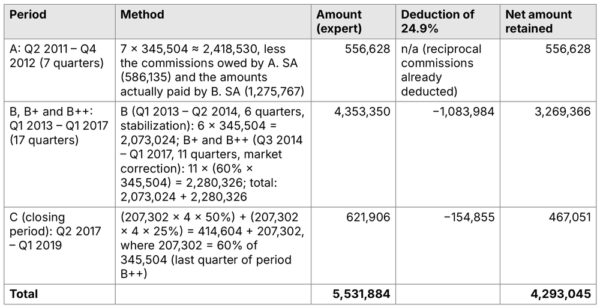
The 24.9% deduction is explained by the fact that, over the period 2007-2012, the commissions paid by A. SA to B. SA represented on average 24.9% of the total commissions. Since the expert had deducted these reciprocal commissions only until the end of 2012, the Cantonal Court applied the same percentage to the subsequent periods.[72] The closing period was included because the Common Index remained the joint property of the Parties after the Contract ended and the products still outstanding continued to generate revenue.[73] A second head of damage amounting to USD 2,266,599 concerned products that had incorrectly been classified as “single-commodity” products (0.20%) rather than “multi-commodity” products (0.50%).[74] The total amount awarded by the Cantonal Court thus amounts to USD 6,559,644 (USD 4,293,045 + USD 2,266,599).[75]
B. First criticism: a reference level already affected by the breach
In our view (based on the data available in publicly accessible court decisions), the reference level that was adopted by the Cantonal Court is open to criticism. The quarterly commissions payable by B. SA to A. SA evolved as follows:[76]
Figure 1 – Evolution of the quarterly commissions payable by B. SA to A. SA (Q1 2010 – Q2 2011), in USD
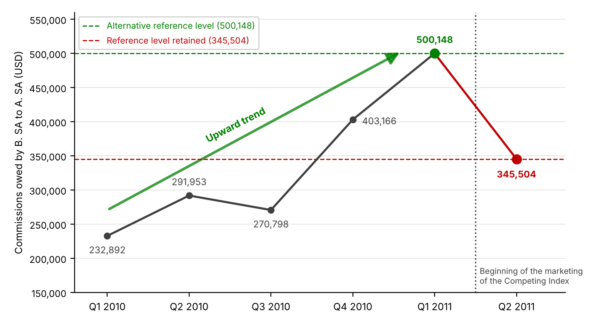
Table 2 – Gross quarterly commissions payable by B. SA to A. SA (USD)
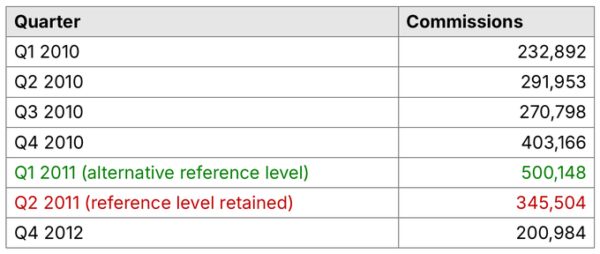
The expert selected the commissions paid in the second quarter of 2011 (USD 345,504), as the normal reference level. She considered that the peak of USD 500,148 recorded in the first quarter of 2011 was not representative of a normal and sustainable level. Yet the second quarter of 2011 coincides precisely with the period in which B. SA began actively marketing the Competing Index. The expert herself observed “that the decrease in commissions in the second quarter of 2011 coincided with the beginning of the marketing of products using the O. index”.[77] The expert therefore adopted as a normal reference level an amount that had already been affected by the breach of the Contract. This is comparable to measuring the amount of water lost from a leaking tank by taking as the reference level the amount of water remaining one hour after the legal began: the water lost during that first hour is never taken into account. An alternative approach would have been to consider that the first quarter of 2011 peak was not an isolated occurrence but rather reflected market growth that could have continued had the Contract been properly performed. Indeed, the trend over 2010 and early 2011 was generally upward (from USD 232,892 in the first quarter of 2010 to USD 500,148 in the first quarter of 2011).
Table 3 – Comparison of the two reference levels
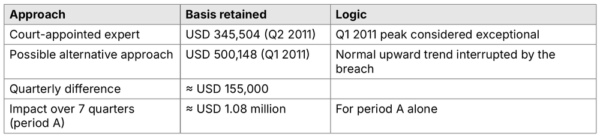
The decision to retain USD 345,504 rather than USD 500,148 thus significantly reduced the amount of damages awarded to A. SA. Although the methodological choice made by the expert and accepted by the Cantonal Court is understandable, it remains open to challenge on its merits.
C. Second criticism: a separate head of damage for the use of an index reproducing the mechanisms of the Common Index
It does not seem excluded that damages arising specifically from the use of an index reproducing the mechanisms of the Common Index could be claimed separately and cumulatively with the first head of damage (see above, section 4.C). The head of damage retained by the Cantonal Court and upheld by the Federal Supreme Court is intended to compensate A. SA for the loss resulting from the reduction in the Remuneration that B. SA would have paid for the use of the Common Index had the Non-Competition Clause not been breached. This head of damage is therefore calculated by applying the Remuneration (art. 4) to a hypothetical business volume that did not materialize because B. SA used another index in breach of the Non-Competition Clause. The calculation thus focuses on the reduction in the use of the Common Index.[78]
A separate head of damage, which was rejected by the Cantonal Court and not addressed by the Federal Supreme Court, could instead relate specifically to the use of an index reproducing the mechanisms of the Common Index. This use also breached the Non-Competition Clause, but the resulting damage is conceptually distinct from the loss arising from the reduced use of the Common Index itself. Admittedly, the derivative use of the Common Index cannot give rise to the contractual Remuneration provided for in art.4, since the Competing Index is not, strictly speaking, the Common Index. From this perspective, one may reasonably assume that the Remuneration payable for using the Common Index itself would be higher than the remuneration that might be payable for using another index that merely reproduces its mechanisms.[79]
The same issue may be examined from the perspective of intellectual property and intellectual property licensing. The Non-Competition Clause prohibits the use of an index reproducing the mechanisms of the Common Index. It could therefore be argued that the party protected by the clause should be entitled to remuneration for such use, potentially calculated by reference to market practices, in addition to the Remuneration payable for the use of the Common Index itself. Indeed, exploiting the Common Index and exploiting indices reproducing its mechanisms may involve different markets and a different forms of commercial use. These may therefore constitute two distinct forms of exploitation capable of giving rise to a separate head of damage. By way of comparison, under an intellectual property license, the holder of an intellectual property right may be entitled to remuneration for different forms of exploitation of the intangible asset covered by the license.[80]
From this perspective, using an index reproducing the mechanisms of the Common Index in breach of the Non-Competition Clause may be compared to exploiting an intellectual property right in aa derivative form rather than using the original protected asset itself. An example would be the use of a derivative work rather than the original work. The main difficulty will thus lie in determining what proportion of the revenue generated by the infringing party should be allocated to the party protected by the Non-Competition Clause. This assessment could depend, in particular, on the reputation of the index concerned and of the companies involved.[81] However, it does not seem appropriate to reject such a claim for damages as a matter of principle simply because the index used in breach of the Non-Competition Clause enjoys greater market recognition than the Common Index jointly developed by the Parties. Such an approach would risk depriving the non-competition obligation of any meaningful practical effect.[82]
Ultimately, it does not seem excluded to claim damages relating to the use of an index reproducing the mechanisms of the Common Index in breach of the Non-Competition Clause, such damage distinct from the damage resulting from the decrease in the use of the Common Index itself. In any event, this case demonstrates the complexity of assessing the damage resulting from the breach of a non-competition clause[83] and the importance of addressing this issue expressly in the contract for instance through a penalty clause.[84]
In short, this judgment reveals the practical and economic importance of financial indices. It also illustrates the difficulties involved in identifying and quantifying the damage resulting from a breach of a non-competition clause. Furthermore, it provides an opportunity to revisit fundamental questions of contract law, particularly the methods of contractual interpretation and the filling of contractual gaps in connection with the legal characterization of a contract.
This case confirms that parties who include a non-competition clause in their agreement (such as a cooperation or joint venture agreement) should expressly regulate the consequences of a breach of a non-competition obligation. They may do so, for instance, by including a contractual penalty clause (arts. 160 seq. SCO) or a contractual remuneration mechanism covering the use of competing products. Such provisions can help avoid the complex contractual, evidentiary and financial difficulties encountered in this case.
[1] Despite the anonymization of the parties in the judgment of the Federal Supreme Court, the dispute was reported in the media, which identified the parties as BNP Paribas (referred to as “B. SA” in the Federal Supreme Court judgment) and Diapason Commodities Management SA (referred to as “A. SA”), the latter having been co-founded by Jim Rogers, creator of the Rogers International Commodity Index (RICI); see https://gothamcity.ch/2024/02/21/bnp-paribas-doit-verser-52-millions-a-une-ancienne-societe-de-jim-rogers/ (about the judgment TF, 4A_95/2023, 12.12.2023, on the procedural question of compliance with the time limit to appeal). It should be noted that the initials used in the judgment of the Federal Supreme Court to designate the parties as well as the other relevant elements of the case (in particular the financial indices) unfortunately differ from those used in the Cantonal Court judgment (see footnote 9). See de Werra Jacques, Coopération portant sur la création et l’exploitation d’un indice financier : quelques réflexions de droit des contrats à propos de l’arrêt du Tribunal fédéral 4A_83/2025 du 16 février 2026, in: Alberini Adrien/Bahar Rashid/Liégeois Fabien/Villard Katia (eds), Retour vers le futur : mélanges en l’honneur de Luc Thévenoz, Geneva/Zurich (Schulthess) 2026, p. 93 seq., p. 95, fn. 6 (hereinafter: de Werra); this case comment is derived from this previous publication.
[2] Rogers International Commodity Index (RICI) (see footnote 1); this index is mentioned in the Cantonal Court judgment (see footnote 9), p. 47 para. 25.
[3] Diapason Commodities Index® (DCI) (see footnote 1).
[4] DCI® BNP Paribas Enhanced, see the press release issued on the day the Contract was concluded (April 12, 2007), available at: https://group.bnpparibas/en/press-release/bnp-paribas-diapason-launch-dci-bnp-paribas-enhanced-brand-approach-commodities-indices.
[5] A more detailed description of the financial and technical features of the indices is beyond the scope of this commentary; reference is made to the facts set out in the judgment of the Federal Supreme Court and in the Cantonal Court judgment (see footnote 9).
[6] TF, 4A_83/2025, 16.02.2026, para. A.e (facts); CACI VD, PT13.018389-240072, 7.01.2025, para. F.9 c (facts).
[7] Namely the S&P GSCI Dynamic Roll, available at: https://www.spglobal.com/spdji/en/indices/commodities/sp-gsci-dynamic-roll/.
[8] TF, 4A_83/2025, 16.02.2026, para. A.g (facts).
[9] Judgment of the Civil Court of Appeal of the Cantonal Court of the Canton of Vaud of 7 January 2025, PT13.018389-240072 (the “Cantonal Judgment”), available at: https://entscheidsuche.ch/dok/VD_FindInfo/VD_TC_002_HC—2024—625_nodate.html. The Cantonal Court judgment uses different initials from those of the Federal Supreme Court: “S.” corresponds to A. SA, “N.” to B. SA, the “E.” index to the “N.” index and the “Q.” index to the “O.” index. The terminology of the Federal Supreme Court is used in this commentary. In the footnotes, the Cantonal Court judgment is cited as “CACI VD, PT13.018389-240072, 7.01.2025”.
[10] TF, 4A_83/2025, 16.02.2026, para. 3.1.
[11] TF, 4A_83/2025, 16.02.2026, para. 3.4.
[12] TF, 4A_83/2025, 16.02.2026, para. 4.2.
[13] TF, 4A_83/2025, 16.02.2026, paras. 5.1.2 and 5.3.
[14] TF, 4A_83/2025, 16.02.2026, para. 5.3.
[15] See e.g. S&P 500, available at: https://www.spglobal.com/spdji/en/about-us/data-index-licensing/; STOXX, available at: https://www.stoxx.com/index-licensing; MSCI, available at: https://www.msci.com/indexes/index-licensing-for-derivatives; Bloomberg Fixed Income Indices, available at: https://www.bloomberg.com/professional/products/indices/resources/index-data-licensing/.
[16] See An Yu/Benetton Matteo/Song Yang, Index Providers: Whales Behind the Scenes of ETFs, Journal of Financial Economics 2023, vol. 149(3), p. 407-433, available at: https://ideas.repec.org/a/eee/jfinec/v149y2023i3p407-433.html.
[17] Despite its interest, this question is not addressed in this commentary; see the sources mentioned by An Yu/Benetton Matteo/Song Yang, Index Providers: Whales Behind the Scenes of ETFs (August 8, 2023), under “Ongoing regulatory investigation”, available at: https://corpgov.law.harvard.edu/2023/08/08/index-providers-whales-behind-the-scenes-of-etfs/.
[18] Heaton James B., Can You Take Me Higher? How the Big Three Benefit from the Dominance of Index Providers, 16 William & Mary Business Law Review 2025, p. 317 seq., available at: https://scholarship.law.wm.edu/wmblr/vol16/iss2/3; de Werra (see footnote 1), p. 94.
[19] Guillod Olivier/Steffen Gabrielle, arts. 19-20, nos 1-5, in: Thévenoz Luc/Werro Franz (eds), Commentaire romand du Code des obligations I, 3rd ed., Basel (Helbing Lichtenhahn) 2021.
[20] See Hemett Sid, Interpretation and scope of a non-competition clause in a share purchase agreement and judicial reduction of an excessive penalty, published on Swiss Contract Law (April 17, 2025), available online at: https://swisscontract.law/40 (hereinafter: Hemett), section 1.A.
[21] See Hemett (see footnote 20), section 1.B.
[22] ATF 144 III 93, para. 5.2.2.
[23] ATF 144 III 93, para. 5.2.3; Hemett (see footnote 20), section 2.A.
[24] TF, 4A_83/2025, 16.02.2026, para. 3.1. In English: “In accordance with the general principles established by case law, the parties’ expressions of intent must be interpreted in two stages, two legal bases potentially coming into play, namely the real and common intention of the parties (art. 18 para. 1 SCO), which is based on what the parties actually wanted, and, subsidiarily, the principle of trust (art. 1 para. 1 SCO in conjunction with art. 2 SCC), whose purpose is to protect the security of transactions (on these general principles, see ATF 144 III 93, paras. 5.2.2 and 5.2.3; judgment 4A_342/2023 of 5 June 2024, para. 5.1.1)”. The Federal Supreme Court thus mentions “two legal bases” respectively applicable to the subjective method (art. 18 para. 1 SCO) and to the objective method (art. 1 para. 1 SCO in conjunction with art. 2 SCC). It seems to have mentioned this for the first time in a judgment cited in the decision commented here (TF, 4A_342/2023, 5.06.2024, para. 5.1). It should be noted in this context that the Federal Supreme Court considers that the subsidiary method of objective interpretation derives from the application of art. 1 para. 1 SCO, which does not seem to be mentioned by other sources (in particular not by established legal doctrine on the law of obligations).
[25] TF, 4A_83/2025, 16.02.2026, para. 3.4. In English: “It follows from the contested judgment that the cantonal court did not clearly distinguish between the subjective and objective criteria of interpretation and thus proceeded in an inappropriate manner. It can nevertheless be understood from the solution adopted that the cantonal court did not succeed in establishing the real and common intention of the parties. It therefore carried out an objective interpretation”.
[26] ATF 129 III 118, para. 2.6. In English: “Since the cantonal judgment is, however, not entirely clear on this point, it cannot be ruled out that the conclusion results from an application of the theory of trust, which constitutes a question of law that the Federal Supreme Court may freely review”; see also the valuable indications given by the Federal Supreme Court on how to interpret (!) cantonal judgments as regards the methods of interpretation of the parties’ intent, TF, 4A_643/2020, 22.10.2021, para. 4.2.3. In English: “6° Where the cantonal court assesses the evidence according to its general experience of life, all the more so where it also relies on subsequent facts (see 5° above), and reaches a conviction as to the existence of an agreement, it is inferred that it interpreted the real intention. Where it uses the words ‘in good faith’ to describe the recipient’s understanding of the declarant’s declaration, it is in principle inferred that it carried out an interpretation according to the principle of trust; it is however not excluded that, even in the absence of these words, its reasoning must be analyzed as an objective interpretation”; de Werra (see footnote 1), p. 97.
[27] TF, 4A_83/2025, 16.02.2026, para. 3.2.
[28] TF, 4A_83/2025, 16.02.2026, para. 3.1; de Werra (see footnote 1), p. 98.
[29] TF, 4A_83/2025, 16.02.2026, para. 3.4.
[30] ATF 140 III 86, para. 2.
[31] ATF 144 III 93, para. 5.4: “This being a question of law whose legal relevance the parties could not ignore, this Court is in a position to rule immediately, without remanding the case to the Cantonal Court, on the basis of the facts established in the contested judgment”.
[32] The seven-point synthesis made by the Federal Supreme Court in an (unfortunately unpublished) judgment is to be welcomed in this respect: TF, 4A_643/2020, 22.10.2021, para. 4.2.3 (see footnote 26); de Werra (see footnote 1), p. 99.
[33] ATF 148 III 57, para. 2.2.1.
[34] ATF 148 V 70, para. 5.1.1.
[35] ATF 77 II 154, para. 4.
[36] ATF 144 V 84, para. 6.2.1.
[37] ATF 132 III 460, para. 4.3.
[38] Oppliger Damien, Interprétation contractuelle – Poids du texte du contrat et clause d’intégralité, in Aktuelle Juristische Praxis – Pratique Juridique Actuelle (AJP/PJA), 2022, p. 1054 seq.
[39] TF, 4A_290/2017, 12.03.2018, para. 5.4.
[40] TF, 4C.94/2000, 20.07.2000, para. 2c; Hemett (see footnote 20), section 2.B.
[41] ATF 136 III 186, para. 3.2.1.
[42] See Hemett (see footnote 20), section 2.B.
[43] TF, 4A_83/2025, 16.02.2026, para. 5.
[44] TF, 4A_83/2025, 16.02.2026, para. 5.1.2, referring to its own case law, i.e. TF, 4A_342/2023, 5.06.2024, para. 5.2; TF, 4A_334/2023, 13.03.2024, para. 3.1; TF, 4A_502/2022, 12.09.2023, para. 4.1; TF, 4C.290/2002, 14.01.2003, para. 2.2.
[45] TF, 4A_83/2025, 16.02.2026, para. 5.1.2, referring to ATF 115 II 484, para. 4a, JdT 1990 I 213; Carron Blaise/Wessner Pierre, Droit des obligations – partie générale, Vol. II, Bern 2024, no. 3275.
[46] TF, 4A_83/2025, 16.02.2026, para. 5.1.2, referring to TF, 4A_449/2019, 16.04.2020, para. 5.4.
[47] TF, 4A_83/2025, 16.02.2026, para. 5.1.2, referring to ATF 122 III 10, para. 5b, JdT 1998 I 119; ATF 115 II 484, para. 4a, JdT 1990 I 213; TF, 4C.413/1993, 25.04.1995, para. 3b; de Werra (see footnote 1), p. 100.
[48] ATF 115 II 484, para. 4a. In English: “There is a gap in the contract where the parties have not regulated, or not completely regulated, a legal question concerning the content of the contract ([…] BGE 107 II 149). Whether the contract needs to be supplemented in this sense must first be determined by empirical interpretation and, if this is unsuccessful, by normative interpretation […]. Insofar as the High Court found that the parties had not considered, and therefore not regulated, the question of a statutory restriction of the agreed termination terms, it answered a question of fact in a binding manner. The plaintiff’s objections in this respect are therefore inadmissible. Insofar as the High Court also concluded, on the basis of a normative interpretation, that there was no contractual provision, its decision cannot be criticized under federal law” (free translation from German).
[49] See de Werra (see footnote 1), p. 100 seq.
[50] TF, 4A_83/2025, 16.02.2026, para. 5.3.
[51] TF, 4A_83/2025, 16.02.2026, para. 5.3.
[52] In the same vein, Müller Christoph, Berner Kommentar: Kommentar zum schweizerischen Privatrecht. Obligationenrecht, Allgemeine Bestimmungen, Art. 1–18 OR mit allgemeiner Einleitung in das Schweizerische Obligationenrecht, Bern (Stämpfli) 2018, art. 18 OR, no. 439; de Werra (see footnote 1), p. 101 seq.
[53] TF, 4A_83/2025, 16.02.2026, para. 5.1.2, referring to TF, 4A_528/2019, 7.12.2020, para. 6.1.
[54] TF, 4A_528/2019, 7.12.2020, para. 6.1.
[55] See de Werra (see footnote 1), p. 103.
[56] As recalled by the Federal Supreme Court, see TF, 4A_83/2025, 16.02.2026, para. 5.
[57] CACI VD, PT13.018389-240072, 7.01.2025, para. 4.1, in particular para. 4.1.4.
[58] CACI VD, PT13.018389-240072, 7.01.2025, para. F.9 a (facts). In English: “Art. 10 ABSENCE OF PARTNERSHIP CHARACTER The Contract shall in no case be considered (sic) as a simple partnership or any form of joint venture”.
[59] See e.g. ATF 134 III 497, para. 4.4.2. In English: “it was not within the power of the contracting parties to exclude, by a contractual clause, that their contractual relationship receive, in law, the characterization corresponding to the manner in which they actually arranged it”; de Werra (see footnote 1), p. 102.
[60] CACI VD, PT13.018389-240072, 7.01.2025, para. 4.1.4.
[61] CACI VD, PT13.018389-240072, 7.01.2025, para. F.9 a (facts). In English: “5. LICENSES 5.1 The Parties shall have the right to use free of charge, without the right to grant sub-licenses, the name ‘S. N. E.’ to designate the E. Index and to refer to it in their marketing and in their business in general” (the “E.” index in the Cantonal Court judgment corresponds to the “N.” index in the judgment of the Federal Supreme Court); de Werra (see footnote 1), p. 102 seq.
[62] See art. 340b para. 2 SCO with respect to non-competition clauses inserted in an employment contract, which are subject to arts. 160 seq. SCO; see e.g. TF, 4A_468/2016, 6.02.2017, para. 6.1.
[63] TF, 4A_83/2025, 16.02.2026, para. 4.2.
[64] TF, 4A_83/2025, 16.02.2026, para. 5.3; de Werra (see footnote 1), p. 103 seq.
[65] TF, 4A_83/2025, 16.02.2026, para. 4.2.
[66] TF, 4A_83/2025, 16.02.2026, para. 5.3 in fine; de Werra (see footnote 1), p. 104 seq.
[67] CACI VD, PT13.018389-240072, 7.01.2025, para. 4.2.2. In English: “However, the appellant no longer disputes that the Q. index [i.e. the O. index] reproduced the mechanisms of the E. index [i.e. the N. index], which is moreover established by the findings of the court-appointed expert (see above, let. F no. 44 ba). It follows that, by marketing the Q. index, the appellant did breach article 7.1 of the cooperation agreement”.
[68] CACI VD, PT13.018389-240072, 7.01.2025, para. 4.3.3.2.
[69] CACI VD, PT13.018389-240072, 7.01.2025, para. 4.4.2; de Werra (see footnote 1), p. 105.
[70] CACI VD, PT13.018389-240072, 7.01.2025, para. 4.3.3.2.
[71] CACI VD, PT13.018389-240072, 7.01.2025, para. 4.4.2.
[72] CACI VD, PT13.018389-240072, 7.01.2025, para. 4.4.2.
[73] CACI VD, PT13.018389-240072, 7.01.2025, para. 4.4.2.
[74] CACI VD, PT13.018389-240072, 7.01.2025, para. 4.7.1.2.
[75] CACI VD, PT13.018389-240072, 7.01.2025, para. 4.8.
[76] CACI VD, PT13.018389-240072, 7.01.2025, para. F.41 (facts).
[77] TF, 4A_83/2025, 16.02.2026, para. B.b (facts).
[78] See de Werra (see footnote 1), p. 105 seq.
[79] See de Werra (see footnote 1), p. 106.
[80] See de Werra (see footnote 1), p. 106 seq.
[81] It being recalled that, in the present case, the Competing Index was considered more commercially attractive because it was better known on the market, in particular in the United States, see footnote 8.
[82] See de Werra (see footnote 1), p. 107.
[83] Which naturally also arises under foreign law, see e.g. under US law the judgment of the Supreme Court of Texas of May 26, 2017, Horizon Health Corporation v. Acadia Healthcare Company, Inc., No. 15-0819 (Tex. 2017).
[84] See de Werra (see footnote 1), p. 107 seq.
Reproduction authorized with the following reference : , "Breach of a Non-Competition Clause in a Joint Commodity Index Cooperation Agreement: How Should Damages be Calculated in the Absence of a Penalty Clause?", published on: Swiss Contract Law, 2026-11-11 10:21:20, https://swisscontract.law/54/